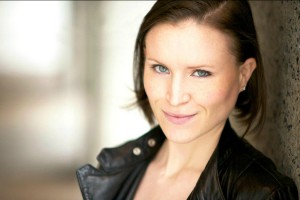
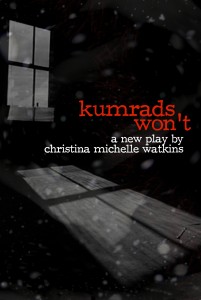
 On this episode, the fabulous director Kristin McCarthy Parker returns to the podcast — and this time, I’m posting our interview in time for you to hear it and then see her show (unlike when I covered her show Bears).
Kristen, along with producer Nick Abeel, playwright Christina Michelle Watkins, & other committed artists, knew they wanted to see kumrads won’t in a real production — so they decided to produce it themselves, submitting it to the New York International Fringe Festival. Self-producing is something I’m all in favor of, but I also know it’s a daunting proposition. So of course one of my biggest questions for the interview were, “why would you do this to yourself?” And in a festival, nonetheless!
Must be a really special show to them. As you’ll hear in the interview, indeed it is.
Listen in as Kristin discusses how she came to fall in love with this play, the stuggles of being vulnerable, and what it means to be successful within your means.
“I found it really intriguing, and funny, and heartbreaking, and sad, but also just a really poignant look at a relationship between two people who are very different, and who we don’t normally envision having any sort of connection, but who are struggling to connect with each other nonetheless.”
Podcast: Play in new window | Download
Subscribe: RSS


 The
The  Mac Rogers is a playwright I seemed to keep missing — for example, I got back into town just late enough to miss the last performance of Advance Man, for which I had a ticket, and I was completely out of town for the entire run of Frankenstein Upstairs. And yet, I kept hearing great things about his work.
 I love returning guests. The conversation can be nice and free and candid, and it’s just plain fun — but then again, all of my experiences with the good folks at